


Files
Download Full Text (3.8 MB)
Contributor
Harr, Jennifer (Faculty Mentor)
Digital Publisher
Digital Commons at St. Mary's University
Publication Date
Spring 2026
Keywords
Microplastic, Chemical Exposure, Muscular Degeneration. Caenorhabditis elegans
Description
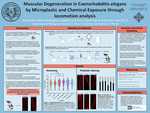
We use Caenorhabditis elegans (C. elegans) as a model organism to investigate the effects of microplastic and chemical exposure on muscle structure and function.
• Microplastics (MP) are pieces of plastic less than 5 μm, and Nanoplastics (NP) are less than 1 μm. Microplastics are man-made pollutants and have been found in the environment and in the food and water sources, including drinks from plastic bottles (Hu, 2020). • Our work relates environmental contamination to potential biological consequences at the muscular level, providing insight into how pollutants may contribute to degenerative damage.
• Polystyrene (PS) MPs alone and combined with di-butyl-phthalate (DBP) lead to reduced fertility and lifespan in C. elegans, with greater defects seen with MPS +DBP than either component alone (Maldonado et al, 2025). • Exposure to MPs of varying size and composition leads to reduced motility in C. elegans and other organisms. (Meng et al, 2025, Li et al, 2024 and Jewett et al, 2022). • Here we test for the effects of MP and combined DBP exposure on two complementary assays: ü Swimming Assays (locomotion, behavioral changes) ü Phalloidin Staining (muscle structure, physiological changes) • The assays will let us understand muscle degeneration caused by microplastics and chemicals. Using phalloidin staining, we can directly compare muscle fibers between normal and abnormal, resulting in uncoordinated swimming movements (Paquette et al, 2023).
Format
Size
1 poster
City
San Antonio, Texas
Creative Commons License

This work is licensed under a Creative Commons Attribution-NonCommercial-No Derivative Works 4.0 International License.