


Files
Download Full Text (1.5 MB)
Contributor
Berroyer, Alexandra (Faculty Mentor)
Digital Publisher
Digital Commons at St. Mary's University
Publication Date
Spring 2026
Keywords
Genes, Nucleotide Excision Repair, DNA
Description
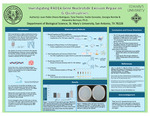
DNA is typically found as a double-stranded helical structure; however, it can be found in different types of structures, such as G-quadruplexes (G4s). These are structures formed when DNA sequences are rich in Guanines, which interact with each other by hydrogen bonding, forming stacked G-tetrads. These guanine-rich structures are known for interacting with DNA during important cell processes, such as recombination and replication, leading to instability and DNA damage (Grey et al., 2014). If not treated properly, these structures may contribute to mutations and cancer development. To solve these issues, cells have developed maintenance pathways such as Nucleotide Excision Repair (NER). NER is known for removing bulky bases by excising DNA damage segments (Scharer, 2026).
As a class project for Cell and Molecular Biology, we were tasked with exploring whether Nucleotide Excision Repair Pathways can remove G-Quadruplex Structures (G4) [Figure 1] from DNA in Saccharomyces cerevisiae (yeast). From previous research in this field, we believe that NER-deficient yeast will be highly sensitive to treatment with G4-binding drugs due to NER removing harmful G4s and preventing G4-induced damage. We were challenged to replace the RAD14 gene in wild-type yeast with the URA3 gene. Which would then allow us to test our hypothesis of whether NER-deficient yeast has higher sensitivity to treatment with G4-binding drugs than NER-proficient yeast.
Format
Size
1 poster
City
San Antonio, Texas
Creative Commons License

This work is licensed under a Creative Commons Attribution-NonCommercial-No Derivative Works 4.0 International License.