


Files
Download Full Text (1.1 MB)
Digital Publisher
Digital Commons at St. Mary's University
Publication Date
Spring 2026
Keywords
Electrocardiogram (ECG), Heart activity, Diagnosing, Deep learning, Artificial Intelligence
Description
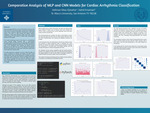
Electrocardiogram (ECG) is a record of the electric activity of the heart over time. ECG analysis plays a pivotal role in diagnosing critical heart conditions. Significant developments have been made in the realm of deep learning and applied artificial intelligence. These deep learning models have been utilized heavily because of their ability to analyze deep morphological features of each signal. The model architecture used in this study is a convolutional neural network (CNN) combined with a multi-layered perceptron (MLP). The MLP acts as an input filter that classifies normal heartbeat signals from abnormal. The CNN is the second filter in the architecture that classifies any signals marked abnormal by the MLP into one of five different arrhythmias: Normal, Supraventricular ectopic beat, Ventricular ectopic beat, Fusion beat, and Unknown beat. The CNN model had a validation accuracy of 98.214% after 10 epochs (iterations) of training and testing. The MLP model yielded similar results during testing with a validation accuracy of 92.305%. These models were trained on Google Colab’s A100 High-RAM GPU environment to ensure the models are robust and industry-applicable. The data used to train these models were made publicly available via resources such as PhysioBank and Kaggle.
Format
Size
1 poster
City
San Antonio, Texas
Creative Commons License

This work is licensed under a Creative Commons Attribution-NonCommercial-No Derivative Works 4.0 International License.