

-
Effects of PTK2 Knockdown on Key Cellular Processes in ES8 Cells
Adrian Cruz, Emiliano Rueda, Dylan Andrews, and Terry Jo Shackleford
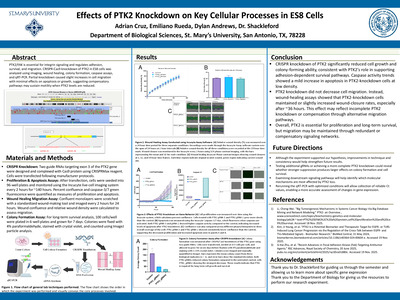
Ewing sarcoma is an aggressive form of pediatric cancer characterized by rapid growth and metastatic potential, with limited treatment options available. PTK2 is a key regulator of many pathways involved in tumor behavior, including integrin-mediated adhesion, survival, and migration. This research lab investigated how CRISPR-Cas9 knockdown of PTK2 can affect cellular processes in ES8 Ewing sarcoma cells. To assess the effectiveness of reducing PTK2 expression, we utilized live-cell imaging, wound-healing assays, measurements of caspase activity, colony formation, and qRT-PCR. Our results showed that incomplete knockdown decreased cell proliferation and colony formation, while also increasing apoptotic activity. Additionally, migratory ability was not reduced. Rather, the knockdown cells maintained normal-or even enhanced-wound closure rates, suggesting a compensatory mechanism to preserve motility. The findings indicate that though PTK2 is an important regulator of key survival pathways, Ewing sarcoma cells appear to rely on alternate pathways to preserve migration when PTK2 levels are diminished. Further research is needed to more accurately identify the mechanisms impacted by PTK2 inhibition.
-
How CXCR4 Knockdown Affects Tumorigenic Properties in ES8 Cells
Gabriella Galdeano, Damon James, and Terry Jo Shackleford
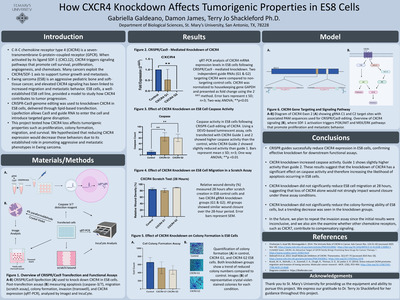
C-X-C chemokine receptor type 4 (CXCR4) is a seven-transmembrane G-protein–coupled receptor (GPCR). When activated by its ligand SDF-1 (CXCL12), CXCR4 triggers signaling pathways that promote cell survival, proliferation, angiogenesis, and chemotaxis. Many cancers exploit the CXCR4/SDF-1 axis to support tumor growth and metastasis. Ewing sarcoma (ES8) is an aggressive pediatric bone and soft-tissue cancer, and elevated CXCR4 signaling has been linked to increased migration and metastatic behavior. ES8 cells, a well-established ES8 cell line, provided a model to study how CXCR4contributes to tumor progression. CRISPR-Cas9 genome editing was used to knock down CXCR4 in ES8 cells, delivered through lipid-based transfection. Lipofection allows Cas9 and guide RNA to enter the cell and introduce targeted gene disruption. This project evaluated how CXCR4 loss affects tumorigenic properties, including proliferation, colony formation, migration, and survival. We hypothesized that reducing CXCR4 expression would decrease these behaviors, given its established role in promoting aggressive and metastatic phenotypes in Ewing sarcoma.
-
Investigating the Role of TWIST1 in Cancer Progression Using CRISPR Knockdown
Abby Guerrero, Sofia Perez, and Terry J. Shackleford
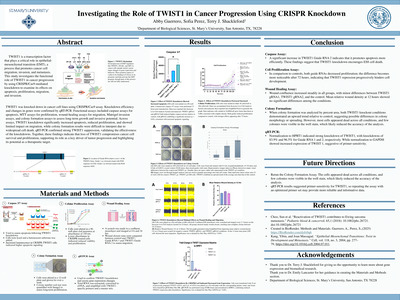
TWIST1 is a transcription factor that plays a critical role in epithelial-mesenchymal transition (EMT), a process that promotes cancer cell migration, invasion, and metastasis. This study investigates the functional role of TWIST1 in cancer progression by using CRISPR/Cas9-mediated knockdown to examine its effects on apoptosis, proliferation, migration, and invasion. TWIST1 was knocked down in cancer cell lines using CRISPR/Cas9 assay. Knockdown efficiency and changes in genes were confirmed by qRT-PCR. Functional assays included caspase assays for apoptosis, MTT assays for proliferation, wound-healing assays for migration, Matrigel invasion assays, and colony formation assays to assess long-term growth and invasive potential. Across assays, TWIST1 knockdown significantly increased apoptosis, reduced proliferation, and showed limited impact on migration, while colony formation results were difficult to interpret due to widespread cell death. qRT-PCR confirmed strong TWIST1 suppression, validating the effectiveness of the knockdowns. Together, these findings indicate that loss of TWIST1 compromises cancer cell survival and proliferation, supporting its role as a key driver of tumor progression and highlighting its potential as a therapeutic target.
-
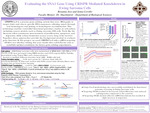
Evaluating the SNA1 Gene Using CRISPR Mediated Knockdown in Ewing Sarcoma Cells
Rosanna Jees, Sonia Cerrillo, and Terry Jo Shackleford
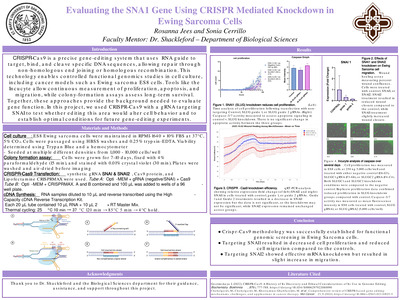
Ewing sarcoma is a pediatric cancer with limited therapeutic options and poor long-term survival. CRISPR–Cas9–mediated gene editing provides a powerful tool for investigating tumor molecular behavior and identifying potential therapeutic targets. In this study, we worked with CRISPR–Cas9 in Ewing sarcoma ES8 cells to evaluate the roles of the transcription factors SNAI1 and SNAI2, both implicated in epithelial–mesenchymal transition and cancer progression. Using guide RNAs targeting each gene, we assessed proliferation, apoptosis, migration, and long-term survival through Incucyte live-cell imaging and colony-formation assays. Knockout of SNAI1 resulted in decreased cell proliferation and reduced migratory capacity compared with controls, suggesting a pro-tumorigenic role in Ewing sarcoma. In contrast, SNAI2 targeting achieved effective mRNA knockdown, but it produced a mild increase in migration without a significant trend. Overall, this work demonstrates successful implementation of CRISPR–Cas9 editing in ES8 cells and highlights differential contributions of SNAI1 and SNAI2 to Ewing sarcoma cell behavior.
-
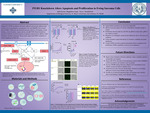
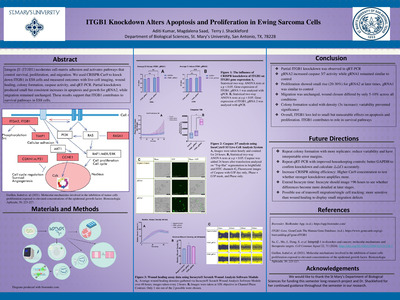
ITGB1 Knockdown Alters Apoptosis and Proliferation in Ewing Sarcoma Cells
Aditi Kumar, Magdalena Saad, and Terry J. Shackleford
Integrin beta 1 (ITGB1) is an adhesion receptor that link cells to the extracellular matrix and regulates pathways involved in survival, proliferation, and migration. In order to understand its role in Ewing Sarcoma, we applied CRISPR-Cas9 with two guide RNAs to knock down ITGB1 in ES8 cells. We then assessed changes in cell growth, death, movement, and gene expression using Incucyte live-cell imaging, colony formation assays, wound healing assays, and qRT-PCR. qRT-PCR showed partial ITGB1 reduction, with ITGB1_gRNA2 producing the strongest decrease. ITGB1_gRNA2 also led to a small increase in caspase activity and a 20-30% increase in proliferation at the later time intervals. Migration remained unchanged, and colony formation varied with density but did not have statistical significance. Partial ITGB1 knockdown produced small but measurable effects on apoptosis and proliferation so ITGB1 does contribute to survival signaling in ES8 cells but may require extending imaging, improved qRT-PCR controls, and more replicates to help clarify these results.
Printing is not supported at the primary Gallery Thumbnail page. Please first navigate to a specific Image before printing.