


Files
Download Full Text (1.6 MB)
Contributor
Berroyer, Alexandra (Faculty Mentor)
Digital Publisher
Digital Commons at St. Mary's University
Publication Date
Spring 2026
Keywords
Base Excision Repair, DNA, Cell biology, Ampicillin, Student Scholarship
Description
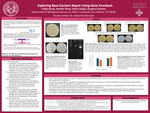
• Base Excision Repair (BER) fixes damaged 3DNA bases throughout the cell cycle by removing damaged bases and replacing either one nucleotide in short-patch BER or a short stretch of nucleotides in long-patch BER. (Hindi, 2021, Cellular and Molecular Life Sciences:CMLS)
• 4G-quadruplexes (G4s) are 4 stranded secondary DNA structures formed in guanine rich areas of DNA and RNA. (Rhodes, 2015, Nucleic Acids Research)
The URA3 plasmid was used as a PCR template to make a gene deletion construct, then yeast were transformed so APN1 was replaced by URA3. 2APN1 encodes a major DNA repair enzyme in yeast, and strains lacking APN1 are hypersensitive to oxidative and alkylating DNA-damaging agents. (Ramotar, 1991, Molecular and Cellular Biology)
• Ampicillin, an antibacterial, and uracil absent plates were used to select for transformed E. coli and yeast cells respectively.
• Previous experiments involving 1single knockout lines have shown it is possible to transform yeast using centromeric plasmids.(Persson, 2022, Genes|Genomes|Genetics),
Hypothesis: The DNA repair pathway Base Excision Repair, will remove G4s from DNA efficiently.
Format
Size
1 poster
City
San Antonio, Texas
Creative Commons License

This work is licensed under a Creative Commons Attribution-NonCommercial-No Derivative Works 4.0 International License.