


Files
Download Full Text (1.1 MB)
Contributor
Gray Christine (Faculty Mentor), Tovar, Ruben (Faculty Mentor)
Digital Publisher
Digital Commons at St. Mary's University
Publication Date
Spring 2026
Keywords
Habitat, Head Shape, Eurycea spp., Subterranean environments
Description
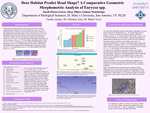
Subterranean environments impose strong selective pressures, including complete darkness and reliance on non-visual sensory systems. In Eurycea salamanders, these conditions are associated with traits such as reduced eyes and expanded head regions that improve sensory detection (Tovar et al., 2025). Subterranean species are often expected to share similar head shapes due to convergent evolution. However, not all species experience these pressures equally. Eurycea latitans is a polymorphic species that inhabits both surface and cave environments. Eurycea sp._NB is an obligate subterranean species, while Eurcyea sosorum is a surface species. This study tests whether habitat predicts head shape in Eurycea, or whether differences in the degree of subterranean specialization better explain variation in morphology by comparing a surface species (E. sos), a polymorphic species (E. lat), and an obligate subterranean species (E. sp._NB).
Format
Size
1 poster
City
San Antonio, Texas
Creative Commons License

This work is licensed under a Creative Commons Attribution-NonCommercial-No Derivative Works 4.0 International License.