


Files
Download Full Text (1.6 MB)
Contributor
Gray Christine (Faculty Mentor), Tovar, Ruben (Faculty Mentor)
Digital Publisher
Digital Commons at St. Mary's University
Publication Date
Spring 2026
Keywords
Groundwater salamander, Environmental factors, Eurycea, Texas, Subterranean habitat
Description
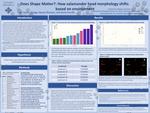
Groundwater salamanders of the genus Eurycea represent a diverse group of amphibians inhabiting the aquifer systems of central Texas, where both surface-dwelling and fully subterranean species coexist. Subterranean habitats impose extreme selective pressures, including complete darkness, limited nutrient availability, and stable environmental conditions, which drive convergent morphological traits such as eye reduction or loss, decreased pigmentation, and elongation of appendages. A key evolutionary pattern seen in these systems is sensory compensation, in which the reduction of one sensory modality, in this case vision, is accompanied by the enhancement of others. In aquatic salamanders, this often involves expansion of the lateral line system, a mechanosensory network that detects water movement through specialized structures known as neuromasts, allowing organisms to better navigate and interact with their environment in the absence of light. In this study, four species: Eurycea latitans, Eurycea sosorum, Eurycea sp. 4, and Eurycea wallacei, were selected to represent variation along the surface-to-subterranean spectrum. E. sosorum, a primarily surface-associated species, retains well-developed eyes, whereas E. latitans exhibits intermediate characteristics. In contrast, E. sp. 4 and E. wallacei display more extreme cave-adapted traits, including reduced or vestigial visual systems.
Format
Size
1 poster
City
San Antonio, Texas
Creative Commons License

This work is licensed under a Creative Commons Attribution-NonCommercial-No Derivative Works 4.0 International License.
Included in
Biology Commons, Evolution Commons, Other Ecology and Evolutionary Biology Commons, Zoology Commons