


Files
Download Full Text (2.7 MB)
Contributor
Segovia, Jesus (Faculty Mentor)
Digital Publisher
Digital Commons at St. Mary's University
Publication Date
Spring 2026
Keywords
Ashwagandha, Stress responses, Inflammation, Cytokines, Oxidative Stress markers, THP-1 macrophages
Description
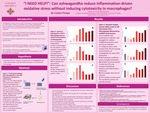
Ashwagandha has been shown to reduce inflammation in humans by lowering pro-inflammatory cytokines and oxidative stress markers, helping regulate immune responses. It is commonly used to support conditions linked to chronic inflammation, such as stress-related disorders, arthritis, and metabolic imbalance. THP-1 macrophages are a part of the body's immune response to inflammation. While they produce a lot of different responses to inflammation, one of them is the production of Reactive Oxygen Species (ROS). N-acetylcysteine (NAC) is established to be a powerful antioxidant and is used as a positive control. My study aims to understand how ashwagandha, a popular supplement, affects the production of ROS in macrophages during an inflammation response.
Format
Size
1 poster
City
San Antonio, Texas
Creative Commons License

This work is licensed under a Creative Commons Attribution-NonCommercial-No Derivative Works 4.0 International License.
Included in
Cell Biology Commons, Immunology and Infectious Disease Commons, Pharmacology Commons, Toxicology Commons