


Files
Download Full Text (1.7 MB)
Contributor
Donoso, Claudia (Faculty Mentor)
Digital Publisher
Digital Commons at St. Mary's University
Publication Date
Spring 2026
Keywords
Korean War, Military Alliances, Korea, United States, China, International intervention, Military conflict
Description
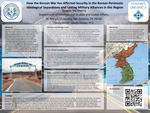
Although the Korean War ended in 1953, its effects continue to shape security on the Korean Peninsula today. This paper examines how the war created long-lasting ideological divisions and military alliances, particularly through the involvement of the United States and China. These alliances have helped maintain stability through deterrence but have also prevented meaningful reconciliation between North and South Korea. I argue that these dynamics reinforce a security dilemma, where efforts to increase security also deepen division and mistrust. As a result, the peninsula remains in a prolonged state of tension, demonstrating how unresolved conflicts can continue to influence global security long after active fighting ends.
Format
Size
1 poster
City
San Antonio, Texas
Creative Commons License

This work is licensed under a Creative Commons Attribution-NonCommercial-No Derivative Works 4.0 International License.
Included in
Asian Studies Commons, International Relations Commons, Peace and Conflict Studies Commons