


Files
Download Full Text (1.3 MB)
Contributor
Van Hoy, Teresa (Faculty Mentor)
Digital Publisher
Digital Commons at St. Mary's University
Publication Date
Spring 2026
Keywords
Ku Klux Klan, Racism, White Supremacy, Organized hate groups, Violence, Hatred, Student Scholarship
Description
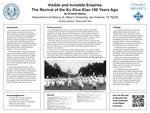
Hatred and violence breed division, and that division breeds more hatred and violence. 1920s American politics was characterized by name-calling, finger-pointing, scapegoating, whataboutisms, and violence. The nation entered a self-perpetuating cycle. Groups keen for growth, power, and profit captured the angry, stressed, and less-informed with lies and misleading numbers. In particular, the Ku Klux Klan captured nearly 4 million Americans, roughly 1 in 12 men at the time. But the Klan, large as it was on a local level, was led and masked by a handful of national leaders. The Klan was not just bands of rogue vigilantes cruising the streets and brutalizing people. Actually, the Klan's real power came from their formal organization and movement, led by smooth talkers and sophists who were protected by law. They published advertisements, hosted speeches, conducted outreach, rallied around key figures, and did all they can to capitalize on hate. When the hate they planted became violence, it was covered up and masked behind the organization's legal posturing. By focusing on just the local violent-doers, we risk missing their enablers; those elites who built the mask under which the violent-doers could act.
Format
Size
1 poster
City
San Antonio, Texas
Creative Commons License

This work is licensed under a Creative Commons Attribution-NonCommercial-No Derivative Works 4.0 International License.
Included in
American Politics Commons, Inequality and Stratification Commons, Race and Ethnicity Commons, Social Control, Law, Crime, and Deviance Commons, United States History Commons