


Files
Download Full Text (6.5 MB)
Contributor
Tovar, Ruben (Faculty Mentor)
Digital Publisher
Digital Commons at St. Mary's University
Publication Date
Spring 2026
Keywords
Gene expression, Eye tissue, Environmental Impact
Description
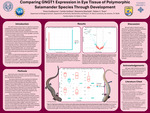
The effect of the environment on organisms and their adaptations is widely studied. When exposed to different environmental niches, phenotypic adaptation is observed even within species. Animals that live in dark cave environments show a loss of their eyesight, since this sense is no longer useful to keep. Previous research has studied salamanders of the clade Eurycea and compared gene expression to subterranean and surface phenotypes1. E.pterophila is observed to express these two phenotypes depending on its environment, either Preserve Cave (subterranean) or Comal Springs (surface). Subterranean variant shows reduced eye volume and assumes to have decreased eyesight. Utilizing RNASeq data, we compare gene expression within development of these two phenotypes to identify which genes are being over-expressed in each phenotype. GNGT1 is a gene that participates in rod formation. It is highly conserved gene in vertebrates that encodes the gamma subunit of transducin, allowing for eyesight perception in low light2,3. Observing the different expression patterns in each phenotype gives us a glimpse in eyesight loss and gene regulation through development.
Format
Size
1 poster
City
San Antonio, Texas
Creative Commons License

This work is licensed under a Creative Commons Attribution-NonCommercial-No Derivative Works 4.0 International License.