


Files
Download Full Text (1002 KB)
Contributor
Berroyer, Alexandra (Faculty Mentor)
Digital Publisher
Digital Commons at St. Mary's University
Publication Date
Spring 2026
Keywords
Nucleotide Excision Repair, DNA
Description
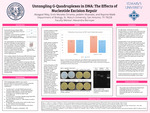
Nucleotide Excision Repair (NER) remo ves bulky DNA lesions that are attributed to UV irradiation, environmental mutagens, and chemo-therapeutic agents (Schärer, CSH Perspectives Biology, 2013). G4- quadruplexes are formed by four guanines hydrogen bonded together to form a planar ring, and stacking of the hydrophobic G quartets stabilizes the quadruplex structure Capra et al.,PLoS Computational Biology, 2010). A surplus of this structure is linked to genomic Instability and cancer development.
Prior studies indicate that because NER eliminates large lesions of DNA, there may be a link to the removal of G4-quadruplexes through Nucleotide Excision Repair (De Magis et al, Nature,2020). Dr. Alexandra Berroyer's research on human cells was applied to this experiment to test if NER-deficient yeast is more sensitive to treatment with G4-binding drugs than in NER-proficient yeast. We hypothesize that NER removes G-quadruplexes from DNA and prevents DNA damage caused by them, which in turn causes NER deficient yeast to display an increased sensitivity to G4-binding drugs.
Format
Size
1 poster
City
San Antonio, Texas
Creative Commons License

This work is licensed under a Creative Commons Attribution-NonCommercial-No Derivative Works 4.0 International License.