


Files
Download Full Text (343 KB)
Contributor
Pierucci, Jillian (Faculty mentor)
Digital Publisher
Digital Commons at St. Mary's University
Publication Date
Spring 2026
Keywords
Impulsivity, Environmental factors, Developmental factors, Multi-media comparison, Shameless
Description
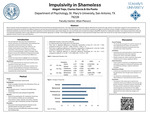
identity exploration and relationships, while keeping social expectations and personal values in balance.
•Impulsivity involves risk-taking, peer influence, role models, and the desire for acceptance or reward. Impulsivity is tied to emotions, experiences, and the process of maturing (Reagan, Osgood, & Kreager, 2025).
•Research shows that impulsivity is shaped by personality traits, past experiences, and environment (Bahr et al., 2005).
•Overall, this study aimed to highlight how an individual's environment and background can impact their impulsivity.
Hypotheses
H1: It was expected that the characters would be more impulsive at school than at home.
H2: It was expected that the characters would be more impulsive during childhood compared to adolescence.
H3: It was expected that there would be more behavioral impulsivity than verbal impulsivity.
Format
Size
1 poster
City
San Antonio, Texas
Creative Commons License

This work is licensed under a Creative Commons Attribution-NonCommercial-No Derivative Works 4.0 International License.
Included in
Developmental Psychology Commons, Personality and Social Contexts Commons, Social Psychology Commons