


Files
Download Full Text (1.1 MB)
Contributor
Gray Christine (Faculty Mentor), Tovar, Ruben (Faculty Mentor)
Digital Publisher
Digital Commons at St. Mary's University
Publication Date
Spring 2026
Keywords
Head shape, Eurycea latitans (E.latitans), New Braunfels, Texas
Description
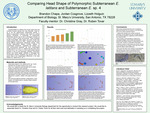
Eurycea latitans (E. latitans) from Honey Creek Cave and unnamed Eurycea species from New Braunfels, Texas (E. sp. 4) are two paedomorphic subterranean species. E. latitans is polymorphic, meaning it also exists as a surface species. Similarities in morphology of subterranean salamander species may be due to convergent evolution as a result of living in similar environments. These similarities include having flatter, wider heads, and wider mouths than surface species (Tovar et al. 2025). Variation may also exist among different subterranean salamander species. Texas Eurycea salamanders display “complex patterns of morphological divergence”, suggesting that isolation and local environmental pressures can drive morphological change (Devvitt et al, 2013). E. latitans may also show some variance from E. sp. 4 due to a more recent surface species ancestor or due to more phenotypic variability. Polymorphic species may exhibit greater variability in phenotype than monomorphic species (Takahashi and Noriyuki 2019). We expect there to be morphological differences in the head shapes of E. latitans and E. sp. 4.
Format
Size
1 poster
City
San Antonio, Texas
Creative Commons License

This work is licensed under a Creative Commons Attribution-NonCommercial-No Derivative Works 4.0 International License.