


Files
Download Full Text (2.7 MB)
Contributor
Boies, Lori (Faculty Mentor); Shackleford, Terry (Faculty Mentor)
Digital Publisher
Digital Commons at St. Mary's University
Publication Date
Spring 2026
Keywords
Urban parks, Metropolitan environment, Urbanization, Environmental impacts
Description
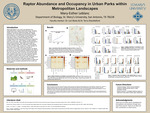
Rapid urbanization is one of the most significant and accelerating drivers of global biodiversity change, reshaping wildlife communities by fragmenting habitat, altering prey availability, and introducing human disturbances. Despite these pressures, some wildlife species are attracted to and may even flourish in urban settings, primarily because urbanization creates an altered landscape that often unintentionally provides resources functioning as components of habitat. (Chiron et al., 2024) Raptors, as apex predators within avian food webs, offer a valuable lens through which to examine these dynamics. While raptor communities are broadly negatively impacted by urbanization, some species can thrive in urban areas. (Leveau et al., 2022) Typically, the raptors that thrive in urban areas are living within a “community,” the diversity of the species present, the relative abundance of each of those species compared to the others in the community, and the role that each of those species takes within the community. (Boal, 2018) San Antonio's park areas span a gradient of park sizes and urban intensities, allowing for analysis of resident raptors across 10 parks and two distinct time periods (pre- and post-COVID). We hypothesized that the urban environment within green spaces of San Antonio would contribute to a higher abundance of raptors and that this could be evaluated using data from the Cornell Lab eBird platform.
Format
Size
1 poster
City
San Antonio, Texas
Creative Commons License

This work is licensed under a Creative Commons Attribution-NonCommercial-No Derivative Works 4.0 International License.
Included in
Ecology and Evolutionary Biology Commons, Environmental Indicators and Impact Assessment Commons