


Files
Download Full Text (1.5 MB)
Contributor
Berroyer, Alexandra (Faculty Mentor)
Digital Publisher
Digital Commons at St. Mary's
Publication Date
Spring 2026
Keywords
Yeaast, Nucleotides, DNA, Cellular biology, Nucleotide Excision Repair in Yeast
Description
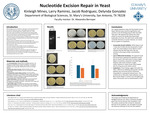
DNA damage occurs constantly in cells due to environmental factors and normal cellular processes, making DNA repair pathways essential for maintaining genomic stability (Hindi et al., 2021). One major repair mechanism is Nucleotide Excision Repair (NER), which is responsible for recognizing and removing bulky DNA lesions that distort the double helix structure (Scharer, 2013). In Saccharomyces cerevisiae (yeast), the RAD14 gene plays a critical role in this pathway by helping identify and initiate repair of damaged DNA (Scharer, 2013). Another source of instability comes from the formation of G-quadruplex (G4) structures, which are secondary DNA configurations that can interfere with replication and transcription (König et al., 2010; Gray et al., 2014). The small molecule drug CX-5461 is known to stabilize G4 structures, thereby increasing DNA stress and potentially leading to reduced cell survival (Xu et al., 2017). Because NER is involved in resolving helix-distorted damage, it is hypothesized that cells lacking functional NER (such as Rad14 mutants) would be more sensitive to CX-5461 compared to wild-type cells (Scharer, 2013; Xu et al., 2017).
Format
Size
1 poster
City
San Antonio, Texas
Creative Commons License

This work is licensed under a Creative Commons Attribution-NonCommercial-No Derivative Works 4.0 International License.