


Files
Download
Download Full Text (1.2 MB)
Contributor
Swain, Ajaya (Faculty Mentor)
Digital Publisher
Digital Commons at St. Mary's University
Publication Date
Spring 2026
Keywords
Artificial Intelligence (AI), Healthcare clinics, Wait times, Patients
Description
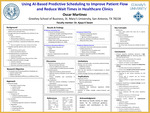
- Healthcare systems face increasing challenges in patient access and wait times
- Average wait times for specialist care continue to rise, creating:
- Delays in treatment
- Reduced patient satisfaction
- Increased system inefficiencies (Sanford, 2025)
- A major contributor is operational bottlenecks, defined as:
- Points of congestion that slow or disrupt service flow
- Hospitals typically operate under process layouts, which:
- Handle diverse patient needs
- Reduce specialization efficiency
- Contributing factors to bottlenecks:
- Physician shortages and burnout
- Administrative burden
- Inefficient scheduling systems (Moura & Pinho, 2025)
- AI offers potential solutions through:
- Predictive scheduling
- Automation of administrative processes
- Data-driven optimization of patient flow
Format
Size
1 poster
City
San Antonio, Texas
Creative Commons License

This work is licensed under a Creative Commons Attribution-NonCommercial-No Derivative Works 4.0 International License.
Included in
Artificial Intelligence and Robotics Commons, Data Science Commons, Health Services Administration Commons, Health Services Research Commons, Operations and Supply Chain Management Commons