


Files
Download Full Text (1.8 MB)
Contributor
Berroyer, Alexandra (Faculty Mentor)
Digital Publisher
Digital Commons at St. Mary's University
Publication Date
Spring 2026
Keywords
Base excision repair (BER), Cellular biology, DNA, Molecular biology
Description
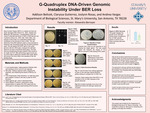
Base Excision Repair (BER) is a cellular tool that can repair damaged DNA (Hindi et al., 2022, Cellular and Molecular Life Sciences). G-quadruplexes (G4s) are unique 4-stranded structures in DNA or RNA that are rich in guanine (Gray et al., 2023, Nat. Chem. Biol). The purpose of this study is to understand whether BER contributes to the removal of G4s in DNA. This will determine if the BER-deficient yeast is more sensitive to treatment with G4-binding drugs than the BER-proficient yeast. We will replace the APN1 gene in the yeast genome with the URA3 gene, because the wild type yeast do not have a functional URA3 gene. This was done by transforming the gene deletion DNA construct we made via PCR. After performing a gene knock-out, we will be able to determine whether DNA repair (BER) will remove G4’s from DNA or be sensitive to the G4-binding drugs.
Format
Size
1 poster
City
San Antonio, Texas
Creative Commons License

This work is licensed under a Creative Commons Attribution-NonCommercial-No Derivative Works 4.0 International License.
Included in
Biochemistry Commons, Biophysics Commons, Genetics Commons, Molecular Biology Commons, Structural Biology Commons