


Files
Download Full Text (2.1 MB)
Digital Publisher
Digital Commons at St. Mary's University
Publication Date
Spring 2024
Contributor
Manandhar, Erendra (Faculty Mentor)
Keywords
Supramolecular Coordination Complexes, Metallacycles, Supramolecular Structure, Molecular Physics
Description
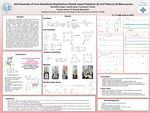
Coordination-driven self-assembly is an efficient way to create 2D and 3D supramolecular coordination complexes (SCC) due to its predictable features of metal coordination. SCC’s represent a growing area of research with applications in various fields such as host-guest chemistry, catalysis, chemical transfer and separation, and stabilization of its reactive intermediate. Integrating various fluorophore/chromophore into these SCC’s results in unique properties and functions. In this project, core-substituted naphthalenediimide (NDI) based macrocycles were constructed via self-assembly with 90° platinum (II) and palladium (II) phosphane triflates.1H NMR and 31P NMR studies of the self-assembled product in various nonpolar to polar solvents showed two major products existed in equilibrium between triangle and square complexes in solution. The equilibrium of these complexes depends on various factors such as temperature, concentration, solvents, and metal ions (platinum or palladium). The macrocycle is functionalized with NDI as it has variable photo physics, a strong absorbance and fluorescence in the visible region, is electron deficient and redox active, easily functionalized and has a tendency to undergo hierarchical self-assembly to form various nano structures with applications in catalysis, organo photovoltaic (solar cells), and sensing. Future work includes UV-Vis absorption, fluorescence, cyclic voltammetry, and ESI mass spectrometry studies of macrocycles and its application as a host for polycyclic aromatic compounds.
Format
Size
1 page
City
San Antonio, Texas
Creative Commons License

This work is licensed under a Creative Commons Attribution-NonCommercial-No Derivative Works 4.0 International License.