


Files
Download Full Text (1.4 MB)
Contributor
Segovia, Jesus (Faculty Mentor); LSAMP Scholars Program; National Science Foundation
Digital Publisher
Digital Commons at St. Mary's University
Publication Date
Spring 2026
Keywords
Mycoplasma Pneumoniae, Community-acquired respiratory distress syndrome (CARDS), inflammation, Lung diseases
Description
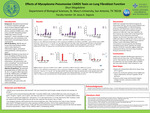
Mycoplasma pneumoniae is a common respiratory pathogen whose virulence depends largely on the community-acquired respiratory distress syndrome (CARDS) toxin, a 591-amino-acid ADP-ribosylating protein¹. CARDS toxin induces immune responses²˒³, causes vacuolation in lung epithelial cells, and contributes to the inflammatory and pathological features of pneumonia. IMR-90 fibroblasts. IMR-90 cells are human fetal lung fibroblasts widely used to study responses to inflammatory signals, extracellular matrix production, and lung injury or repair. Rationale. Fibroblasts are key drivers of tissue remodeling and fibrosis during lung injury. Defining how CARDS toxin influences fibroblast programs in inflammation, cell-cycle control, and matrix remodeling²˒³ will clarify how M. pneumoniae promotes chronic remodeling and pathological outcomes. Objective & hypothesis. We examined how graded doses of CARDS toxin (40, 20, 10, 5, 2.5 µg/mL) affect expression of TGF-β1, CDKN1A (p21), and MMP-1 in IMR-90 cells. We hypothesized that CARDS toxin would dose-dependently upregulate genes linked to inflammation, cell-cycle arrest, and matrix remodeling.
Format
Size
1 poster
City
San Antonio, Texas
Creative Commons License

This work is licensed under a Creative Commons Attribution-NonCommercial-No Derivative Works 4.0 International License.