

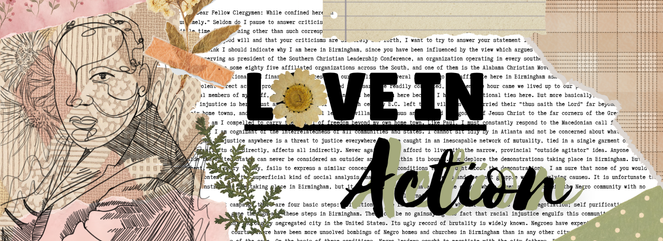
Love-In-Action: Poetic Practice for an Audacious Community
Sometimes, when the world closes in too tight, when the darkness sweeps in without warning, when despair settles across the shoulders of a loved one, I journey back to a 1963 Alabama jail cell. In my mind’s eye, I watch Dr. Martin Luther King, Jr. write his love letter of power – or maybe it’s a power letter of love – that we know as the Letter from Birmingham Jail.
After reading a recent PEN America report on book bans across twenty-three states and news articles on word bans in various federal agencies, I returned to the Letter for guidance once more, asking, “What response might it offer to counter this silencing of the American voice?” Its answer was steadfast, the same as it was over sixty years ago: the four steps of non-violent direct action, or what has also been called, Love in Action.
- Collection of Facts: What are the facts needed to understand injustice?
- Negotiation: What has been done or is ongoing regarding the injustice?
- Self-Purification: How do we prepare ourselves to engage in civil disobedience to challenge the injustice?
- Non-Violent Direct Action: By which actions of love can we challenge the injustice?
These four steps of civil disobedience can be adapted to the practice of writing poetry. When writing a poem, we gather facts about the subject, whether that’s the smell of a magnolia in bloom or the cry of a child in a detention camp. We learn about negotiations on the subject, whether that’s a decision to plant milkweed to sustain the monarch’s migration or to redistrict electoral boundaries to weight votes. We engage in self-purification to clear our minds and hearts before picking up the pen to capture these experiences. And, finally, when we are ready, we craft poems that bear witness, ask questions, and demand reckoning.
When books and words are banned, poetry assumes its place as non-violent direct action. It becomes a daring and bold practice to nourish an audacious community. An audacious community that does not fear words or ideas. An audacious community that risks care of its members. An audacious community that speaks truth to power to make the dream of the Beloved Community a reality.
The following collection animates these four steps for a poetic practice to nourish just such an audacious community. To do so, it highlights four themes that permeate the Letter.
- An Inescapable Network of Mutuality
- A Single Garment of Destiny
- A Notorious Reality
- A Degenerating Sense of Nobodyness
An inescapable network of mutuality grounds us in the fact that all of us experience life on our fragile, beautiful Earth, together. This fact is inescapable. There is, as the saying goes, “no planet B” for all y’all nor for me. This reality compels us to weave a single garment of destiny, under which we reckon our interdependence and nurture a sense of belonging.
When that sense is fractured by the notorious reality of unjust treatment, violence, or scapegoating, we rend and fray this single garment, leaving too many exposed and experiencing a degenerating sense of nobodyness. Dr. King spells nobodiness in his Letter as nobodyness. That choice, to maintain the “y” instead of changing it to the “i” of the correct spelling, highlights the personhood of the nobody, instead of the generality of nobodiness. Every nobody deserves to be recognized as somebody, to experience somebodyness.
These four themes provide the overarching structure for Love-In-Action: Poetic Practice for an Audacious Community. Each theme is subdivided into the four steps of Love in Action. Collection of Facts contains an overview of and links to resources to understand different issues associated with the theme. Negotiations contains an overview of and links to resources to learn the state of the conversation on the issues associated with the theme. Self-Purification offers a series of reflective practices to prepare one to write activist poetry. Finally, Non-Violent Direct Action consists of poetry, itself.
These poems of Love in Action, written by outstanding San Antonio area poets, crystalize a wide range of visions in relation to each theme. I am deeply grateful to these generous contributors, especially San Antonio Poet Laureate Eddie Vega. Eddie helped me identify and invite these daring poets, who risk voicing the silence left in the wake of banned books and banned words, to participate in this unconventional collection.
I also want to thank the St. Mary’s University community, particularly two exceptional graduate English students, Christa Neumann and Mary Arnolds, for bringing this project to fruition. Christa created the original artwork, conducted research, formatted and loaded the material into the StMU Digital Commons, under the guidance of the indomitable Elizabeth Goode of Blume Library. Mary conducted research, formatted and copy edited the manuscript.
Finally, I do not take for granted the gift of colleagues who encourage and support thinking outside of the box; thus, I offer my deep appreciation to Dr. Josh Doty, chair of the English Literature and Language Department, Interim Dean Betsy Smith of the College of Arts, Humanities and Social Sciences, and the Marianists, the founders and animators of St. Mary’s, who have risked love in action for their students over the past two centuries.
Browse the Love in Action Collections:
A Degenerating Sense of Nobodyness