

Files
Download Full Text (4.2 MB)
Publication Date
Spring 2026
Keywords
Microplastics, nano-plastics, microorganisms, cells, cellular biology
Contributor
Lancaster, Emily (Faculty Mentor)
Description
Microplastics (MPs) are defined as small plastic particles that come from the degradation of plastics [Ziani et al. 2023], that hold a regular or irregular shape, ranging from 1μm to 5 mm [Campanale et al. 2025]. This diminutive size makes them virtually impossible to remove once released into the environment[Lee et al. 2023]. Furthermore, biological, chemical, and physical processes break MP's further down in the environment, causing them to exist in nano-level sizes (1nm-1μm) [Lee et al. 2023], further exacerbating their threat to critical habitats. However, recent studies have shown MP contamination expands beyond the natural environment as recent studies revealed the presence of MPs in tap water systems (TWS) worldwide, including treated drinking water, distributed water and household/public tap water [Sun et al. 2024].
As a method of mitigation, enhanced coagulation-flocculation, rapid sand filtration, membrane bioreactors, have been implemented in water filtration systems to remove microplastics, showing a 99% removal rate. However, as these filtration methods are designed to remove biological contaminants and sediment greater than 1um, nano-size microplastics quickly bypass these barriers, inevitably reaching our household taps.
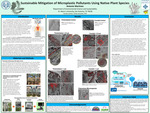
In this experiment we explored the phytoremediation capabilities of Pontederia Cordata and Ceratophyllum demersum to serve as sustainable and cost-efficient phytoremediators for municipal water systems to remove nano-size microplastics (< 1μm). For this experiment we hypothesized Texas native plants; Pickerelweed(P. Cordata) and Coontail(C. demersum) to efficiently remove microplastics/nano-plastics from their environments as previous studies demonstrated the water hyacinth (same genus as P. Cordata) to be a highly effective phytoremediator for microplastics, effectively up taking microspheres down to .5μm from its environment. However, coontail is not closely related to the water hyacinth, but due to its fully submerged growth style and its highly prolific growth in nature, it may offer superior microplastic uptake capabilities.
Collection
Culminating Research Experiences
Format
Medium
Poster
Size or Duration
1 page
City
San Antonio, Texas
Creative Commons License

This work is licensed under a Creative Commons Attribution-NonCommercial-No Derivative Works 4.0 International License.
Recommended Citation
Martinez, Antonio, "Sustainable Mitigation of Microplastic Pollutants Using Native Plant Species" (2026). Culminating Research Experiences. 3.
https://commons.stmarytx.edu/culresexp/3
Included in
Environmental Microbiology and Microbial Ecology Commons, Other Cell and Developmental Biology Commons, Plant Sciences Commons