

-
The Missing Lynx: Investigating Passive and Active Rewilding with the Eurasian Lynx
Isaiah Charles, Tatiana Flores, and Isabella Lopez
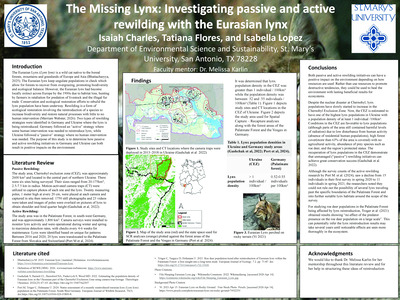
The Eurasian Lynx (Lynx lynx) is a wild cat native to the boreal forests, mountains and grasslands of Europe and Asia (Bhattacharyya, 2025). The Eurasian lynx keep ungulate populations in check which allow for forests to recover from overgrazing, promoting biodiversity and ecological balance. However, the Eurasian lynx had become locally extinct across Europe by the 1900s due to habitat loss, hunting by farmers in retaliation for predation of livestock and the illegal fur trade. Conservation and ecological restoration efforts to rebuild the lynx population have been underway. Rewilding is a form of ecological restoration involving the reintroduction of a species to increase biodiversity and restore natural processes with little to no human intervention (Merriam Webster, 2026). Two types of rewilding strategies were identified in Germany and Ukraine where the lynx is being reintroduced. Germany followed an “active” strategy where some human intervention was needed to reintroduce lynx, while Ukraine followed a “passive” strategy where no human intervention was needed. The purpose of this study is to determine how passive and active rewilding initiatives in Germany and Ukraine can both result in positive impacts on the environment.
Printing is not supported at the primary Gallery Thumbnail page. Please first navigate to a specific Image before printing.