

The Computer Science program at St. Mary's University prepares students to apply computational thinking, technical expertise, and innovative problem-solving skills to a wide range of technological challenges. Through coursework, research, and experiential learning opportunities, students develop a strong foundation in software development, data analysis, cybersecurity, and emerging computing technologies. This collection represents graduate students MS comprehensive projects.
-
Robot Remote Control Utility
Jeremy Cantu and Paul Uhlig
The purpose of this document is to describe the Robot Control Management Utility developed in the course of this graduate project. Information included in this document will include the background of the developed product, as well as the functional requirements, data structures, software modules, interface design, installation guide, and sample and troubleshooting guides.
-
Solving Rubik's Cube by Using Artificial Intelligence
Polat Coban and Seth Reed
This document will detail a proposal to build a Rubik’s cube simulator, and a Rubik’s cube solver. It is broken into several sections which in turn are broken into subsections.
-
KTA System Manual
Cayden Garcia
The purpose of this document is to explain the ins and outs of KTA. This includes but not limited to:
- The problem that colleges face when it comes to data analysis and collection
- The history of data analytics at a collegiate level
- Software and hardware requirements for KTA – Developer and User
- The overall design of KTA, how the software is structured and how the stack interacts with one another
- How to install KTA on your machine
- Sample Sessions – including issues that the user may run into and how to fix them
-
Smart ATM
Majid Hakeem
The Smart ATM is a new system that goal is to create a new experience for ATMs users by creating a different way of using the ATM. It would protect users from germs and bacteria. Instead of using buttons and touch screens, the main input for this system will be the motion sensor. To specify, the system uses Microsoft Kinect, which is the motion sensor for the Xbox One.
This document is a user guide, which is intended to give assistance to users for using the Smart ATM. This document contains an application overview, list of user requirements, the design of the system, sample sessions of application, how to install the system for both users and developers, how to use the system and troubleshooting to solve the problems in using the system.
-
E Classroom+
Ami B. Jariwala
A software platform that enhances many processes correlated with learning is called a learning management system (LMS). It is also known as a management software package that enables the delivery of learning content, resources and activities and also that handles the correlated administration operations. In classrooms, today, teachers, are being commenced with convenience to remodel learning from a traditional transmission model to a student-centered model where students are mostly responsible for their learning. The research conveys that in order to remodel learning, schools require to support a student-centered approach where students can be supported in finding, analyzing, organizing, evaluating, internalizing, and commencing new instructions. Today, educational institutions are needed to balance educational outcome with financial bottom line, including demonstrating a rapid return on their technology investment. Doing more with less has become a way of life for educational as it has in the business world. At the same time, Universities are operating in an increasingly challenging environment and global marketplace. Synchronous online learning is a cost-effective solution that gives global access with lower total cost of ownership. To overcome budgeting concerns, the starting point for the Universities, is a need to provide students with a high-quality level of service called distance education.
-
Idioma Tutor
Oralia Mijares
The Idioma Tutor was developed specifically for individuals who desire to learn English through a non-traditional approach, eLearning. Idioma Tutor is an interactive game designed to strengthen individual’s English language adaptation, using an individual-learner approach. The game uses immediate feedback to provide self-analysis for learners. It captivates users and applies best-practices in eLearning and game development to retain and fully engage learners. This system manual outlines provides detailed information for using the Idioma Tutor. This system will be used as a catalyst to support the success of individuals who desire to learn the English language in a fun and interactive manner where few, non-traditional methods of achieving this goal exist. This system enables flexibility for personalized learning and supports the user in development of individual competency-based needs. Individuals are often pressed for time; as a result, their availability to learn a new skill is self-prescribed a non-priority; Idioma Tutor is a unique response to these individuals as it tailors learning to their preferences and fosters true, authentic learning.
-
PharmEd. System Manual: HoloLens Application
Eden Woldeselassie
This document provides the full life cycle of PharmEd HoloLens. PharmEd stands for Pharmacy Education. The overall document will go through the complete system manual by going over requirements, followed by design, how to install the application, how to upload the application to Microsoft store, troubleshooting and source code. The first section will explain the background, the existing problems and why the need to develop PharmEd. Here techniques of requirement gathering and some statistics will elaborated. The following section discusses about functional requirements. The requirement section includes subtopics: functional and nonfunctional requirements for both -programmer and end user- and the programming language being used for the development. The next section is the design section which includes flow chart of how modules interconnect among each other and 3D models. Followed is a section that discusses where to find the application and how to download it. Sample sessions of the application will be displayed and elaborated following the installation section. This document includes some problems that a user might face and a work around solution in a table format. Finally, complete code can be found after the references page.
-
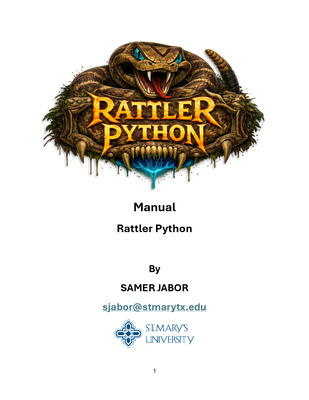
Rattler Python
Samer Jabor
The Rattler Python project is an interactive game-based learning system that intends to teach the basic concepts of Python programming through guided instruction, gameplay challenges, and review-based assessments. The document contains a proposal for this system consisting of problem definition, background research, existing solutions, and the proposed product, together with the system scope, assumptions, and the organization of the remainder of this document.
-

Garage Sale Web-based Information System
Sonachi Mogbogu
The Garage Sale web application is in response to a business need of an online interactive system. This system will support the interaction between owners and shoppers of garage sale event. The online information system is a great idea to implement because it will help create sales awareness which will lead to increase in the customer base, and increased sales for event organizers. People are used to the traditional approaches, advertising events through word-of-mouth and posting signs alongside roads, however, having an online information system will be more effective in reaching a wider market of buyers. The traditional approaches do not provide enough information about the garage sale events, but with an information system available, shoppers will have access to full garage sale details. The system will allow shoppers to search for garage sale events in a specified location. In addition, event organizers will be able to post event details which will be available to the public through the online system. Finally, the system will provide users with features needed for interacting with the system efficiently and effectively.